


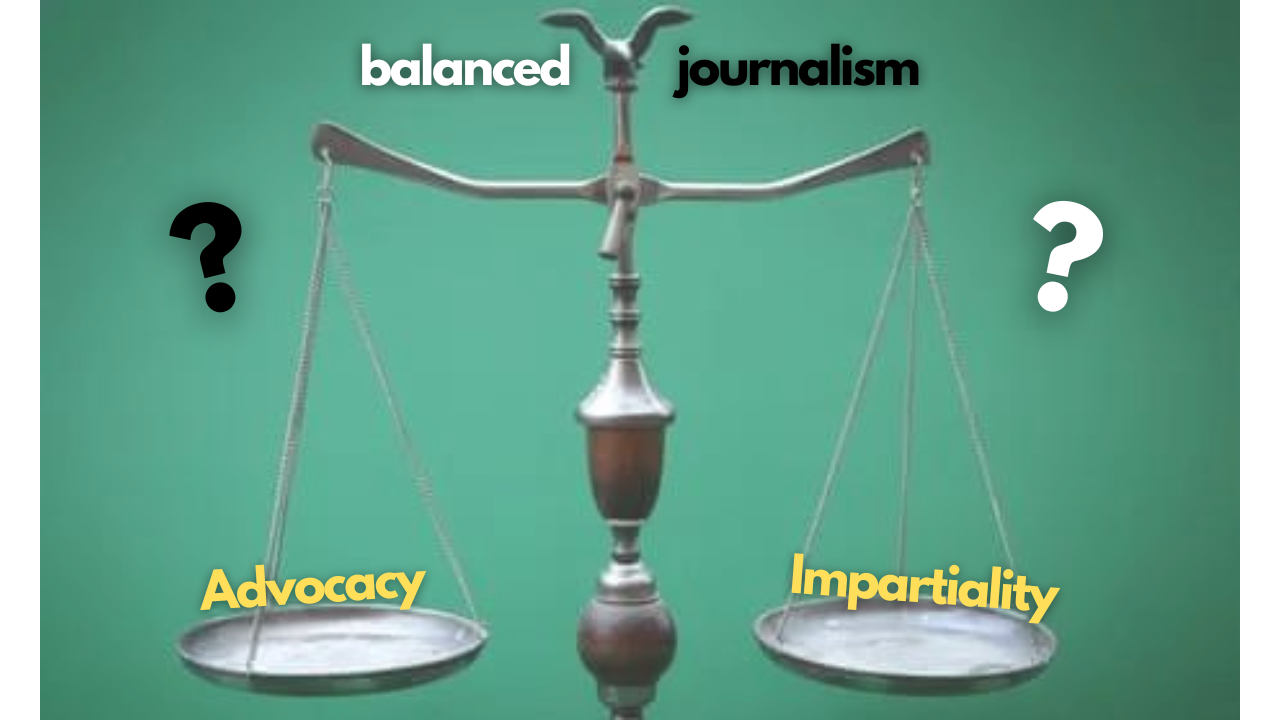
Journalism Is Losing Its Balance in the ‘Objectivity War’: 5 Reasons Why Staying Impartial Could Be Your Secret to Success

by Ewan MacKenna, co-founder and editorial director at Writers’ Bloc.
3 out of 4 (76%) of Americans think journalists should cover all sides of a story—so why do more than half of journalists disagree?
In 2022, a panel of respected journalists and academics—Lewis Raven Wallace, Wesley Lowery, Masha Gessen, David Greenberg, and Andie Tucher—gathered at Columbia University to address a critical question:
Does “both-sides journalism,” the traditional model of presenting all perspectives in a story, still hold relevance in a divided world?
For many younger journalists, the answer is no.
They argue that in times of heightened political tension and widespread misinformation, neutrality can seem like complicity. But this shift away from balance comes at a cost.

According to a 2022 Pew Research survey done in the US, while 55% of journalists believe not every side deserves equal coverage, a striking 76% of the American public still expects balanced reporting. This gap has helped erode trust between the media and its audience.
How do you, as a journalist, navigate this growing divide?
How can you report stories with integrity, present multiple viewpoints, and still stay true to the facts?
Most importantly, how can you do all of this while building a successful career?
This post offers practical strategies to help you master balanced journalism—without compromising your values or financial success.
Let’s explore how balance, ethics, and objectivity are not just old-school ideals but powerful tools for long-term career growth.
Why Balanced Journalism Matters More Than Ever
Balanced journalism isn’t about presenting false equivalence. It’s about giving readers the tools to think critically and form their own opinions.
Journalists aren’t here to dictate morality or define the “right” side. We’re here to deliver information and context, empowering the audience to discern what’s true and fair.
The danger of abandoning balance is real.
When journalists sidestep multiple perspectives, we risk alienating audiences who feel unheard. This erosion of trust is already happening. A significant portion of the public believes that the media is biased, failing to represent their views. And when trust in journalism fades, so does the industry’s ability to thrive financially.
The good news is, balance isn’t just a moral imperative—it’s a career-boosting strategy. Readers crave journalists they can trust. Publications want writers whose stories resonate with broad audiences.
If you can master this, you’ll gain loyal followers, increase your demand, and grow your income, all while adhering to the ethics that define good journalism.
How to Balance Integrity with Financial Success: 5 Simple Tips to Master Impartiality
Ethical journalism and financial success don’t have to be at odds. In fact, doing the hard work to balance integrity with profitability can pay off in the long run, leading to more varied opportunities and more inbound requests.
Here’s how you can start applying these principles today.
1. Balance Source Selection
Balanced reporting begins with your sources. If your sources all come from one side of the debate, your story will too. But when you actively seek diverse viewpoints, you create a richer, more trustworthy narrative.
What to do: Go beyond your usual sources. If you’re covering a policy issue, reach out to voices from different political, social, and economic backgrounds. Seek out both the experts and the people directly affected by the issue. For example, when covering healthcare reforms, talk to policymakers, healthcare workers, and patients.
Outcome: This kind of balanced source selection builds credibility. Readers trust you more when they see a wide range of perspectives, and editors notice when your reporting reflects depth. Over time, this can lead to greater professional opportunities and more robust financial success.
2. Fact-Check & Verify (twice!)
Balancing perspectives doesn’t mean giving airtime to falsehoods. Journalists must rigorously fact-check every claim to ensure that readers are presented with truth, not misinformation.
What to do: Fact-check all statements from your sources, even during interviews. Push back on claims that are unsubstantiated. When covering contentious topics, such as political scandals or controversial legislation, hold both sides accountable by asking for evidence and verifying every detail.
Outcome: This practice ensures that your work is not only balanced but credible. Readers appreciate reporters who take the time to verify facts, and editors value your commitment to integrity. As your reputation for accuracy grows, so will your demand and ability to command higher fees.
3. Avoiding False Equivalence
Not all sides of an argument are equally valid. Presenting them as such can mislead readers and contribute to public confusion.
What to do: Be transparent about the credibility of the information you present. For example, if one side of a debate is supported by empirical evidence and the other by opinion, explain that distinction to your readers. Take the issue of vaccine skepticism: presenting pro-vaccine science on equal
footing with anti-vaccine conspiracy theories would be false equivalence. Instead, explain why one perspective is rooted in verified science, while the other is not.
Outcome: By offering context and differentiating between fact and opinion, you prevent misinformation from skewing your reporting. This reinforces your authority and helps you retain the trust of your audience.
4. Contextualisation Is Key
Context is what transforms facts into a narrative. Without it, even the most well-researched story can feel one-dimensional or misleading.
What to do: Provide historical, social, and cultural background to the stories you cover. When reporting on social issues, include the broader history of the conflict or policy in question. For example, when discussing criminal justice reform, trace the issue back to earlier laws and events that shaped current debates.
Outcome: Offering context deepens your reporting and makes it more engaging. It shows readers you’ve done your homework, and editors value the added layers of meaning you bring to a story. Over time, this strengthens your standing as a reliable journalist.
5. Separate Advocacy From Journalism
As journalists, we all have beliefs and causes we care about. But our role is to report, not advocate.
Readers rely on us to provide balanced information, not to push an agenda.
What to do: Keep your advocacy work separate from your reporting. If you feel strongly about an issue, consider writing an op-ed or a personal piece rather than including your opinions in a news story.
For example, if you’re reporting on environmental stories, which are often contentious, always make sure you’re presenting the facts and perspectives fairly, even if you personally support one side.
Highlighting where doubts or contradictions arise (especially stemming from your own opinions) can have an outsized effect in building audience trust – you are signalling that you’re comfortable saying “I don’t know”, or that there may be competing perspectives which each have merit.
Outcome: By maintaining this separation, you build long-term trust with your readers and editors. This opens doors to new assignments, higher-profile publications, and better compensation as your reputation for integrity grows.
BONUS: Cognitive Superposition
If you want to go down the rabbit hole on this topic (we recommend that you do), you could check out this article on the idea of ‘Cognitive Superposition‘ by Karan Acharya, derived from quantum physics, the Schrödingers Cat thought experiment and the idea of quantum superposition.
Acharya says “the human mind recurrently generates multiple superposition-ed realities for an outcome to be experienced in the future ; and these realities only collapse into one only when the outcome is actually ‘experienced’ in the present moment“.
Basically, how comfortably can you hold multiple competing ideas in your head, and the various complexities associated with each?
Chris Williamson often references this idea, and also how to side-step your cognitive biases – a key skill for any great thinker.
(PS. if you’re finding this content useful, please share it with someone else who also needs it – if you find it useful, so will they!)
The Bigger Picture: Why This Matters for Journalism Today
The shift away from balanced reporting isn’t happening in a vacuum. Newsrooms, publications, magazines and journalists today face increasing pressure from corporate ownership, social media algorithms, and the demand for click-driven content.
These forces push journalists and contributors toward sensationalism, creating an environment where presenting a full, nuanced story can feel like swimming against the tide.
But here’s the catch for media execs: audiences are smart.
Smarter than they’re often given credit for.
Think to your own experience…you can more often than not recognise when a story is biased or incomplete.
People are quick to lose trust in outlets that seem to be pushing a specific agenda – especially if it is quickly or easily falsified. In contrast, publications known for balanced, well-researched journalism continue to thrive, even in today’s fast-paced, polarised media landscape.
By committing to balance, you’re not just doing the right thing ethically—you’re setting yourself up for long-term success in an industry where trust is the ultimate currency.

Putting It into Action: A Cheat Sheet for Balanced Journalism
Ready to put these principles into practice? Here’s a quick guide to help you start now:
1. Diversify Your Sources
Action: For your next story, reach out to at least one credible source with a perspective different from your own.
Outcome: You’ll create a more nuanced, in-depth story that appeals to a broader audience and commands greater authority.
2. Fact-Check in Real-Time
Action: During interviews, question claims that seem misleading or one-sided. Don’t wait until after the fact to challenge inaccuracies – do it in the moment.
Outcome: This reduces the risk of falsehoods landing in your story, preserving your reputation for accuracy (and, by proxy, creating a strong habit of diligence).
3. Neutral Language
Action: Review your drafts for emotionally charged language. Replace any loaded terms with neutral, descriptive ones.
Outcome: Readers will trust that you’re informing them, not influencing them.
4. Add Context
Action: Include the historical or social context behind the issue you’re covering; the omission of which is glaringly obvious in many articles. Stand-out by adding context.
Outcome: This adds significant depth to your reporting. It shows readers you’ve done the hard work & research, integral to giving them the complete picture (more of that diligence habit, again).
Final Thoughts: Building a Lasting Career on Integrity
It’s easy to chase the quick win—write a sensational story, rack up the clicks, move on to the next viral topic. But that approach has a short shelf life.
Readers may click once, but if they don’t trust you, they won’t return.
Balanced journalism, on the other hand, builds trust over time. It creates a loyal audience that respects your work. Publications will value your stories because they resonate with readers. In turn, you’ll see better opportunities, more demand, and the ability to charge higher rates.
Fair Warning: you might alienate the tabloids with this approach – but is that really a bad thing?
The choice is clear: short-term gain or long-term respect? Integrity is your path to sustained success in journalism.
Was it worth the read? Share this article with someone else who could use it. If you found it helpful, they’ll probably find it useful too!
If you want even more, that’s great! Kindly feel free to book a call with our team today to refine your approach to balanced reporting and boost your career prospects.